Running a business already takes time, energy and a lot of hard work. You take care of your customers, manage your team, and try to grow each month.
But there’s one thing that makes all of this harder:
When people can’t find you online.
At Fruit Punch Digital, we help small businesses show up on Google so customers can discover them easily. For years, SEO (search engine optimisation) had clear rules: use good keywords, write useful content, fix technical issues, earn backlinks, and you would climb the rankings.
But recently, something big has changed.
Google has started using AI (artificial intelligence), and it’s totally changing how search works.
We want to explain (in plain and simple language) what this means for your business and how you can stay ahead.
What is AI (in simple language)?
AI just means computers are getting smarter. Instead of just following simple commands, AI systems can learn, understand, and even make decisions all on their own.
In the past, Google was like a simple “matching machine”. If someone typed “best electrician in Wellington”, it looked for webpages that had those exact words.
Today, Google acts more like a smart assistant.
It tries to understand what people really mean, and then finds the most helpful answer – even if the words are slightly different.
This is why AI is such a game-changer.
Google is now understanding meaning, not just words
Google uses AI models (like BERT and MUM) to read and understand the meaning behind each search. It can even pull the best single paragraph from a long article if it thinks that paragraph answers the question better than any other result.
Here’s what that means for your business:
- Helpful and original information is rewarded
- Pages with “keyword stuffing” or low-value text get ignored
- Real stories, real experience and clear explanations rank better
In 2024, Google ran its largest ever update, removing 45% of low-quality pages from search results (Search Engine Land, 2024).
That alone tells us how serious it is about quality over quantity.
Google is now answering some questions before users even click
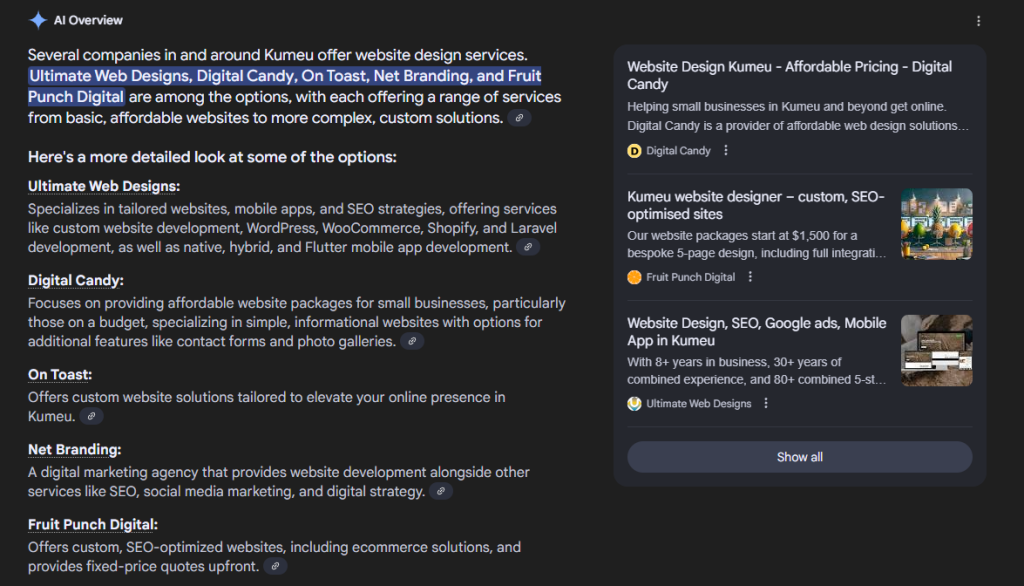
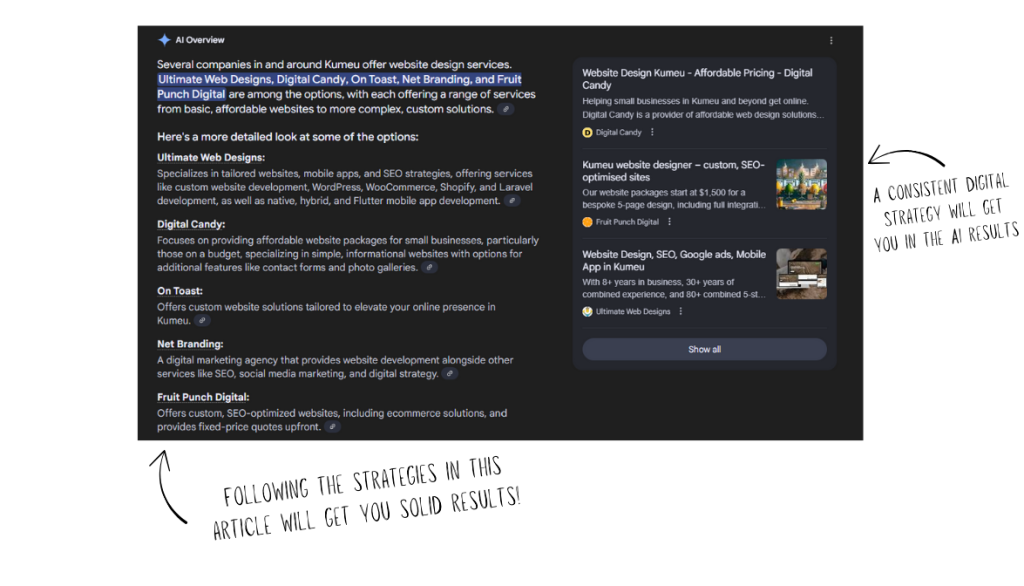
You may have seen it yourself: you type a question, and Google shows a small AI summary box at the top of the page. It’s called an AI overview.
It pulls bits of information from different websites and puts them together into a short answer.
People read that — and sometimes they don’t even click on any links.
In fact, studies show that up to 70% fewer people click on normal links when an AI answer appears above the results (SparkToro, 2024).
So now it’s not just about “ranking #1”.
It’s about being the trusted source Google uses when it builds that AI answer.
The good news is: Google does include links under its AI summary. If your content is good enough to be quoted, you can still get clicks – and often higher quality clicks from people who are already interested.
How we use AI to help – without losing the human touch
We use AI tools every day at Fruit Punch Digital – and they’re incredibly helpful.
They help us:
- Scan websites quickly to find technical issues
- Generate ideas for blog titles and headings
- Draft small pieces of content (like meta descriptions or FAQs)
- Analyse data faster (like search keywords and traffic patterns)
This means we don’t waste time on repetitive tasks — and can spend more time developing smart strategies for our clients.
But here’s the important part: we never ever let AI write full articles or publish anything on its own.
Why? Because AI content often:
- Repeats what’s already on the internet
- Misses real-life experience
- Can contain mistakes or made-up facts
That’s why every piece of content still goes through a human SEO expert.
We check it, improve it, personalise it, and make sure it reflects your business.
Google has actually warned businesses not to use AI just to publish lots of “thin” content (Google Search Central, 2023).
So using AI with smart human editing is the safest – and most effective – approach.
What happens when AI is used badly?
We’re starting to see lots of websites pump out hundreds of AI-generated posts just to try to rank.
They look similar, use the same phrases, and don’t add anything helpful for users.
Google can now detect this (using its own AI spam detection tools) and often pushes these pages down or removes them completely.
In other words…
AI + no human = risk
AI + human = strong long-term SEO
Why this matters for you
Some small business owners in New Zealand think, “That’s okay – those changes only affect the big markets like the US or UK.”
But that’s not true.
Google uses the same AI systems all around the world – including in New Zealand.
We’ve already seen Kiwi businesses lose rankings after the 2024 core updates because their pages weren’t helpful or original enough – even our other website for Side Hustles NZ took a hit.
But the good news is: New Zealand businesses that use AI wisely and produce authentic content can punch above their weight and even reach global audiences faster than ever.
So… what should you actually do right now?
Here are 8 simple actions we recommend for all business owners:
- Write for humans first. Share your knowledge, answer real questions, and keep it simple.
- Avoid keyword stuffing. Use natural language – Google now understands what you mean.
- Add structure. Use headings and FAQs so Google can quickly pull answers.
- Keep your site fresh. Update old pages. Add new examples or case studies.
- Show experience. Use real stories, results, and expert opinions (Google loves E-E-A-T).
- Be visible in more places. Post helpful content on YouTube, TikTok, or local forums — AI tools use those sources too.
- Monitor how you appear in AI answers. Even if you get fewer clicks, you may still be seen and trusted.
- Ask for help when you need it. SEO is getting more complex – the right partner can save you time and stress.
Final thoughts
AI isn’t here to replace SEO – it’s here to evolve it.
In the past, SEO was about adding the right keywords and hoping for the best.
Now, SEO is about being the most helpful, trusted source – so Google (and its AI) chooses you when people look for answers.
Businesses that adapt will stay visible.
Businesses that ignore these changes may slowly disappear from the search results – even if they used to rank well.
If you’d like help navigating SEO in the AI era, we’d love to support you.
See how our SEO services work: https://fruitpunch.digital/search-engine-optimisation/
Check real results from clients just like you: https://fruitpunch.digital/wall-of-wins/
Let’s keep your business easy to find – no matter how smart Google becomes.
Source Links
Google Search Central (AI-generated content guidance)
https://developers.google.com/search/blog/2023/02/ai-content-guidance
Google Blog – Generative AI in Search (I/O 2024 announcement)
https://blog.google/products/search/generative-ai-search-overview/
Google Blog – AI in Search: Going Beyond Information to Intelligence
https://blog.google/technology/ai/ai-in-search-io-2025/
Search Engine Land – How Google Uses AI in Search
https://searchengineland.com/how-google-uses-ai-in-search-430750
Search Engine Land – 2024 Google Algorithm Updates Overview
https://searchengineland.com/google-algorithm-updates-2024-434098
Search Engine Journal – AI for SEO: Can You Work Faster & Smarter?
https://www.searchenginejournal.com/ai-for-seo-work-faster-smarter/477648/
Search Engine Journal – AI-Powered Search: Adapting Your SEO Strategy
https://www.searchenginejournal.com/ai-powered-search-adapting-seo/503226/
Search Engine Journal – Why Generative AI Isn’t Killing SEO
https://www.searchenginejournal.com/generative-ai-seo-opportunities/505023/
SparkToro (Rand Fishkin) – 2024 Zero-Click Search Study
https://sparktoro.com/research/google-zero-click-searches
SparkToro (Rand Fishkin) – Google Search Grew 20%+ in 2024
https://sparktoro.com/blog/google-search-grew-20-percent-2024/
Gartner – Marketing with GenAI (via SEJ Summary)
https://www.searchenginejournal.com/gartner-study-marketing-teams-using-genai/505332/


